 The art of piano pedaling is not an exact subject: it cannot be measured or divided into scientific categories.
As I told you in my previous tutorial – there is no such thing as a ‘correct’ pedaling. What is ‘correct’ for Bach is certainly ‘incorrect’ for Chopin! What is ‘correct’ for the Viennese classics (Haydn, Mozart and Beethoven) is certainly ‘incorrect’ for Debussy or for the expressionist music of the XXth century!
The basic pedaling techniques which I showed you in the first part of my pedal tutorial (for example the delayed pedal or the simultaneous pedal) can be used in thousands on different ways.
So how can we be sure that our pedaling is musically appropriate?
The use of the pedals in a certain piece depends on many ‘variables’. Some of these variables are subjective and difficult to explain: talent, creativity, inspiration, hearing. Others are a little more objective – for example the harmonic structure of the piece, the meaning and the ‘layout’ of a certain phrase or motif, the character of the music and the style of the composer.
Just as I promised in my previous article – this tutorial will be dedicated to the art of using the pedals depending on the style of the composer. In the second part of the article I’ll also describe the basics of pedal notation.
Enjoy the video! I know I had a great time making it, even if I had no time to practice all the fragments I play as examples :).
Nowadays there is a lot of controversy among pianists about when and how we should use the pedals.
Some pianists like to follow certain strict pedaling rules. For example, there are piano teachers who consider that we should play Bach, Haydn and Mozart without pedal, simply because they wrote their works for the harpsichord (and not for the modern piano). Some prefer a rich pedaling, while others like the austere sonority of a ‘dry’, ‘economic’ one – and the list can go on!
Music is a subjective art and so is piano playing. Everyone is entitled to their opinion – and I think that diversity is certainly a good thing! It allows us to explore all the facets of the wonderful piano pieces we’re playing.
That’s why I’m not writing this article for saying who’s right and who’s wrong. I simply want to share with you the pedaling guidelines we use in the Russian piano school, and also the main pedaling tricks and secrets I use on a daily basis, also recommending them to my students.
In my fist pedaling tutorial Using the Piano Pedals – The Art Behind the Mechanism I showed you the functions of the piano pedals and the main pedaling techniques. We all need to master these techniques, but we should also know when and how to use them.
Here is when the ability to understand musical styles comes to our rescue. By learning the main ‘characteristics’ of each musical style, by distinguishing the ‘colors’ and ‘textures’ of each musical epoch, you’ll be able to apply the most suitable pedaling techniques. First, it will be a question of adapting your pedaling to your theoretical knowledge. In time, however, this process will become intuitive and extremely comfortable.
Using the Pedals in Playing Baroque Music
1. The music written for the harpsichord and the organ should be played WITH pedal on the piano. Why? Here are the reasons:
- The harpsichord didn’t have dampers and its strings could resonate longer than the strings of the piano; for achieving the same effect on the piano and avoiding a ‘dry’ sonority, we need to use the sustain pedal.
- The powerful and deep sonority of the organ remains on the same level for as long as we keep the keys pressed; it’s impossible to play organ works on the piano without using both the sustain and the soft pedals. The sustain pedal helps us to create a better continuity and a deeper, more powerful sonority, while the soft pedal allows us to change the color of the sound (imitating a switch of the organ registers) and to make it more distant.
2. The sustain pedal has to be used carefully, especially in polyphonic pieces. We have to avoid ‘blurring’ the melodic line or ‘gluing’ together incompatible sounds or harmonies. We need to use the pedal only in certain places, for creating certain effects – for example making a better legato or emphasizing a specific harmony, rhythmical structure or articulation mark.
3. The pedal should be changed often and we need to make good use of the ‘half’ pedaling technique :).
4. We can also use the middle (sostenuto) pedal, especially in playing Bach’s organ works. It can help us to sustain only certain notes (for example the bass), at the same time keeping all the other voices as detached and transparent as possible.
Using the Pedals in Playing Classical Music
1. The French harpsichordists (Lully, Couperin, Rameau etc.), Haydn and Mozart. In playing the music written by these composers, we should use the pedal sparingly, in a smart manner, only in certain places – depending on the character and the meaning of the music.
2. Classical music is the reign of logic, balance and harmony – that’s why our sonority has to be clear, transparent and luminous. Using too much pedal (or not changing it as often as necessary) can make classical pieces sound too heavy and stylistically inappropriate.
3. Beethoven was the first composer who used the pedals actively in his playing AND writing. However, we should remember that there was an amazing evolution in his style – and we have to use the pedals according to these stylistic changes:
- his early works remind us of Haydn and Mozart’s style – and the use of the sustain pedal should be reduced to a necessary minimum – only for emphasizing certain effects or ‘amplifying’ the resonating properties of the instrument when needed.
- his late works make the transition between the classical and the romantic eras, and the use of the pedals should be modified accordingly: we can use more often the delayed pedaling technique and other thick, rich pedaling effects – they will help us to create dramatic contrasts and bright colors (which are characteristic for Beethoven’s late works).
- Beethoven had an orchestral thinking. Some researchers say that he used his piano Sonatas as a ‘research lab’ for creating his symphonies. In his piano works, the pedal has not only a sustain function, but also the role of making the piano sound as an entire symphony orchestra!
- Beethoven also used the soft pedal, writing una corda in the score each time the use of the left pedal was needed for changing the timbre of the sound and making it softer.
Using the Pedals in Playing Romantic Music
1. The romantic piano music cannot be played without pedal. Romantic composers (Schubert, Mendelssohn, Chopin, Schumann, Liszt, Franck, Brahms, Grieg) wrote their piano works for the hammerklavier (the modern piano with a hammer/string/damper mechanism and 2-3 pedals), creating the structure of their pieces according to the ‘upgraded’ capacities of the new instrument :).
2. The romantic piano pieces have a wide structure that comprises the entire keyboard (as compared to the compact structure of the classical works). All the pianistic innovations of this epoch were made possible, first of all, by the invention of the sustain pedal. By allowing the strings to vibrate even after the pianist has released the keys, this pedal helped romantic composers to create a new type of piano technique: arpeggios that cover the entire keyboard, wide jumps, a rich harmonic sonority with a large diapason – it’s impossible to connect these wide structures without using the sustain pedal!
3. The sustain pedal is extremely important in playing romantic pieces with a lyrical character. By using the delayed pedaling technique, we can improve our phrasing, make a better legato and enrich the sonority of the piece – this way making the piano SING.
4. Sometimes, we can play several bars without changing the pedal (for example, the beginning of Chopin’s Nocturne op. 27 in D flat Major which I play in the video) – of course, with the condition that the harmonic ‘background’ remains the same (in our case – D flat Major). For using such a pedal the melody needs to be very deep and expressive, ‘hovering’ above the accompaniment provided by the left hand. Otherwise, if the melody is not played considerably brighter and deeper than the left hand, it is dangerous to play all these bars on the same pedal – we risk creating a dirty sonority!
5. The romantic music is extremely diverse and multilateral: different characters and emotions (lyrical, dancing, tragic, sarcastic, dramatic, heroic, serene, picturesque, divine and demonic, feminine and masculine) are fighting, peacefully alternating or intertwining – many times in the same piece or fragment – for creating musical images of an amazing emotional power. The use of the pedal should always be subordinate to the character of the played fragment: we should use not only the ‘traditional’ delayed pedal, but also short simultaneous pedals, half pedals, quarter pedals, fluttering pedals and so on!
Using the Pedals in Playing Impressionist Music
1. Musical impressionism was inspired from the subtle game of shadows and blurred colors used by impressionist painters – Monet, Renoir, Pissaro etc. Impressionism is about reflecting the general impression ‘imprinted’ in our mind (or in our emotions) by a certain image, event or character. It appeared as a reaction to the romantic style, replacing obvious musical images with subtle suggestions.
2. Debussy and Ravel created a totally new pianistic structure, inventing new colors of the sound and new uses for the piano pedals. However, you should keep in mind that their music was inspired not only from the art of the impressionist painters. We can find the roots of their stylistic innovations in the works of the French harpsichordists of the XVIII century.
3. The use of the pedals should be subordinate to this interesting ‘symbiosis’ between the exact, accurate sonority (inspired from the harpsichord music) and the blurred, slightly dissonant one (inspired from the impressionist paintings). Debussy and Ravel use all the 3 pedals in their works (many times in unusual combinations) for achieving extremely original effects.
Using the Pedals in Playing the Music of the XXth Century
1. The XXth century was the era of stylistic experiments: atonal and expressionist music on one side, neoclassical on the other, not to mention the neo-romantic tendencies and so on!
2. In playing experimental music, our main pedaling guide is the score. Modern composers usually indicate exactly when and how we should use the pedals and what ‘sound effects’ we should achieve. And, of course, we can always experiment when playing modern music! 😉
Short Conclusion
As a conclusion, I will say that starting with Beethoven, all composers used the pedals in writing their piano works. BUT we need to use the pedals in playing baroque and classical music as well, for emphasizing certain characters, for making a better legato, for enriching the sonority and changing the timbre of our instrument.
Of course, the above pedaling guidelines cannot cover the amazing complexity of the entire pianistic repertoire. They are only general road directions that will hopefully help you have a better understanding of this subject and trigger your curiosity for learning more about the particularities of each musical style.
And a bonus pedaling tip: we all know that each rule has its exceptions. However, let’s concentrate a little on a simple yet very useful rule: always analyze the harmonic ‘skeleton’ of the piece you’re playing! Usually, the use of the sustain pedal is determined by the harmonic structure of the piece – especially in classical and romantic works. By assimilating this simple rule, it will be easier for you to deal with the baroque, impressionist and atonal exceptions! 😉
Now we have finally reached the last part of my pedaling tutorial – pedal notation! Fortunately, this is a very easy topic, so I’ll try to make it very short :).
Sustain Pedal Marks
1. Traditional sustain pedal marks:
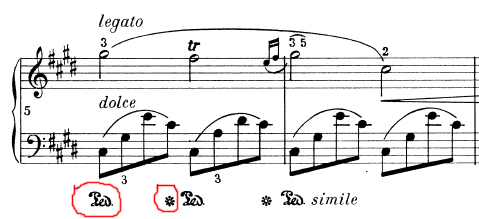
Engage pedal – Ped
Release pedal – *
2. Modern schematic marks (for example ____/\___|)
This pattern is meant to ‘show’ you how and when to engage and release the pedal.
- Horizontal lines symbolize a depressed pedal;
- Diagonal lines indicate a change of the pedal (or a temporary release);
- Vertical lines indicate where we should release the pedal.
While these patterns seem extremely convenient, personally I prefer the ‘warmer’ design of the traditional marks :).
Soft Pedal Marks
Engage pedal – una corda;
Release pedal – tre corde.
However, be aware that the use of the soft pedal is not always indicated in the score, especially in the works of baroque and classical composers (sometimes in romantic music as well). So never forget to keep your hearing sharp and your imagination ‘tuned’ – they will tell you when the use of this pedal is required by the musical content.
Sostenuto Pedal Marks
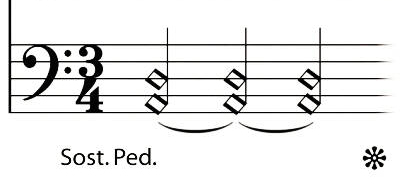
Engage pedal – Sost. Ped.
Release pedal – *
The middle pedal is rarely used, that’s why you may encounter other pedal marks – for example giving the notes which have to be sustained with this pedal a hollow, diamond-shaped ‘design’.
And a bonus pedal notation tip: no matter how sophisticated the pedal marks in your score are, they still can’t fully reflect all the details of an inspired, musically appropriate pedaling. That’s why you don’t have to follow the pedal indications exactly (especially when playing baroque, classical and romantic music). Simply trust your sense of style and your hearing and don’t allow the sonority to become dirty, cluttered with dissonant sounds.
In the end of this loooooong 2-part tutorial, I will say again that achieving a ‘perfect pedaling’ is not our purpose :). Our purpose is enjoying what we do, exploring the amazing pianistic repertoire and sharing it with our friends/audience and, of course, improving our pianistic skills so we could send the message of the performed pieces as best as possible! An appropriate use of the pedals is simply a means to this end!
P.S. If you’re practicing a certain piece and you’re not sure if you’re using the appropriate pedaling – share your dilemma in the comment form below! 😉
Don’t miss my next tutorials – follow PianoCareer.com on Facebook, Twitter and Google +!
If you enjoyed this free online piano lesson, here are some other piano learning and practice topics you’ll like:
Understanding a Piano Piece: 11 Basic Steps
How to Use the Sustain Pedal Correctly: The Bio-Mechanics of a Healthy Piano Pedaling Technique
The life-changing benefits of learning classical music
Why I sometimes ‘stray’ from the musical text in my tutorials: a holistic investigation
No piano? How to practice anywhere
piano pedal notation, pedal symbol piano, pedal markings piano, piano pedal symbol, pedal simile, pedal notation piano, piano pedal markings, pedal sign, pedal markings in piano music, piano notation, piano symbols, pedal symbol, pedal markings, sheet music pedal notation, sustain pedal symbol, sustain pedal notation, pedal sign in piano, piano pedal symbols, pedal notation, what do the foot pedals on a piano do, piano sheet music pedal notation, with pedal piano notation, piano pedal sign, pedal sign piano, damper pedal symbol