Important: this entire tutorial is also available in Japanese! Find the Japanese translation here.
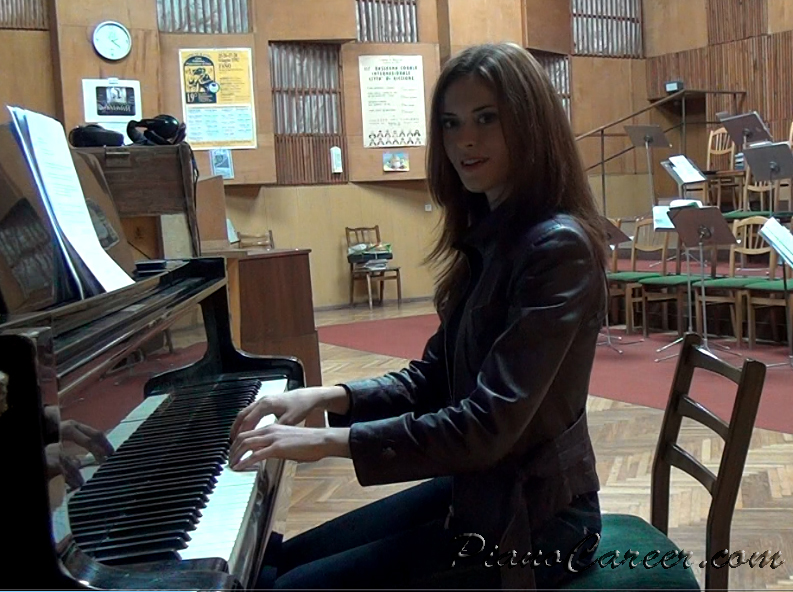 Piano playing is a flexible art. For playing well and feeling good at the piano we have to be flexible and relaxed – both mentally and physically.
Why, then, do we need to have a ‘correct’ posture? Why can’t we simply play however we want and follow our musical intuition?
Actually, we can  . But we have to be ready to face the consequences!
If we want to interact harmoniously with the piano without affecting our health, if we want to ‘become one with the instrument’, to ‘tame’ it and achieve a beautiful sound and a good technique, we need to find that place (and posture) where the functionality of our body naturally meets the functionality of the piano mechanism.
This is what a correct piano posture is – that magical place where two worlds intersect  .
.
Enjoy the video (and don’t forget to change its settings from 360p to 720p to watch it in HD)!
As you can see, having a proper position at the piano does not mean being ‘rigid’ and immobile. And, definitely, you don’t have to keep your body and your arms in a certain way simply because your teacher told you so!
A proper posture is a set of wise, ‘ergonomic’ guidelines that help us to access, in a comfortable, healthy and relaxed way, the entire range of expressive possibilities of the piano.
Having a correct posture at the piano means working smart:
- it allows you to feel good at the instrument and enjoy your practice;
- it protects your spine and your arms from tension-related injuries;
- it allows you to have an amazing power of expression and a brilliant technique;
- it simplifies your practice and increases your productivity;
- it saves you time and effort;
- it ‘unlocks’ new horizons of unexplored possibilities;
- it allows you to fully develop your potential and your pianistic skills;
- it gives you confidence;
- it gives you freedom.
As I told you in the video, having a correct piano posture is not complicated. You just need to keep in mind 5 basic elements:
1. Your attitude and your state of mind.
Just take a deep breath, relax your mind and your muscles – and smile! Then sit at the piano.
2. The piano bench.
When adjusting the height of the piano bench, make sure that your elbows are aligned with the keyboard (you can also place them slightly higher than the keyboard, this way increasing your leverage). Don’t sit too far from the instrument or too close – you need to be able to reach all the keys and you should avoid the uncomfortable ‘backward pointing elbows’! Also, don’t sit on the whole bench – it’s recommendable to only use the front half.
 3. Your back.
My teacher always used to say: you should feel like a queen (or like a king) at the instrument. How can we have such a dignified, noble attitude if we’re slouching? Keep your back straight – it’s good for your health, your self-image and the quality of your playing! Also, don’t stretch your neck forward – keep it well-aligned with the spine.
4. Your legs and your feet.
Don’t place your feet under the piano bench! You need stability when playing – that’s why it’s best to place your feet near the pedals (and make sure they are well-grounded), or on the pedals (depending on the piece you’re practicing).
5. Your arms – consisting of your shoulders, elbows, wrists, knuckles and fingers.
Avoid tension! Your arms should always be relaxed, like the wings of a bird or the paws of a cat. Keep your shoulders down and your elbows at a comfortable distance from the body. The wrist allows us to ‘breathe’ when playing – a flexible, relaxed wrist is the best remedy against tension! It also allows us to have a beautiful, deep and soft sound. The hand should form a ‘dome’ with rounded knuckles and fingers.
And a bonus element :
A correct posture goes hand in hand with a correct key attack: Play from the shoulders, not from the fingers or the elbows! Only by involving your entire arms in the playing process, you can channel the weight of your body and the energy of the sound (which originates in our mind and materializes in our back) into the keyboard.
I will write more about the secrets of a correct piano touché in my future articles and videos! In the meantime, let’s continue to discuss the proper piano posture! Post your thoughts, share your experience or ask me a question in the comment section below!
Did you catch my ebook “A New Perspective on Piano Phrasing“? I’m offering a complimentary FREE copy to all my email subscribers!
This entire tutorial is also available in Japanese – translated by Yuko Agata Farman (Nationally Certified Teacher of Music in Piano), a good friend and a member of PianoCareerAcademy since 2012
Click here to watch the video with Japanese subtitles.


Don’t miss my future posts! Follow me on Facebook, Twitter and Google +.
If you enjoyed this free online piano lesson, here are some other piano learning and practice topics you’ll like:
Take A Deep Breath – Relax Your Wrist!
The Secrets of a Correct Piano Key Attack
How to avoid piano injuries | Get rid of tension and pain in your hands, arms, and back
Why I sometimes ‘stray’ from the musical text in my tutorials: a holistic investigation
No piano? How to practice anywhere
proper piano posture, piano posture, piano hand posture, piano ergonomics, ergonomic piano, correct piano posture, sitting at a piano bench, posture piano, piano height posture, piano playing posture, piano correct posture, pianist posture, piano keyboard height ergonomics, ergonomic piano chair, ergonomic piano fingers, piano posture diagram, correct posture for piano, ergonomic piano bench, proper piano height, good piano posture, piano sitting position, proper piano bench height, correct ergonomics, posture for piano, posture at the piano