 In terms of correct piano practice, which form of articulation is the most useful for beginners – legato, non-legato or staccato? Do these main articulation effects have the same impact on your technical development? The answer is simple – no. Legato, non-legato and staccato are performed by using various touches and, even more importantly – different directions of movement:
- non legato is achieved by moving the entire weight of your arm towards the keyboard – a downward vertical movement;
- for playing legato, we need to move our hands, arms and wrists horizontally – parallel with the keyboard;
- and lastly, for a quality staccato, our hand needs to jump from the keyboard – a specific upward vertical movement that help us to play a short detached sound.
Before analyzing staccato and its influence on our playing reflexes, let’s talk a little about articulation and its meaning.
Music is a part of the universal balance. It has the amazing power of reflecting all the kaleidoscopic aspects of life. But how can we achieve meaning and expression in music? A small part of this process is a great mystery – being explained as talent, genius or inspiration. The rest is hard work, combined with the knowledge of HOW to translate feelings and thoughts into different means of expression: sound character and quality, dynamics, touché, articulation, rhythm, tempo and phrasing.
By mastering the art of skillfully using and combining these means of expression, we can create an infinite number of musical images: from the transcendental severity of Bach’s polyphonic works to the delicate subjectivity of Chopin’s Nocturnes; from the luminous grace of Haydn or Mozart’s Sonatas to the deep, epic wideness of Rachmaninoff’s Piano Concertos.
Articulation (or the touch we use to bring up certain characters in different notes), is one of the most important means of expression. Just imagine how many states, images and feelings we can evoke by using different forms of articulation! Non-legato and legato can make a musical phrase romantic or severe, tragic or dramatic, monumental or fragile.
Staccato, on the other hand, is usually the realm of humor, irony, playfulness and sometimes sarcasm (for example, in Prokofiev’s music). This articulation technique is extremely necessary whenever we come across these specific images. However, according to the traditions of the Russian piano school, staccato should be avoided during the first months of piano practice (until the student has fully assimilated the weighted whole-arm non-legato and legato).
So why is staccato dangerous for beginners and why should we avoid it? Let me explain:
For a piano beginner, every move is important. The first year of practice is the period when we ‘build’ our correct posture and technical foundation.
A healthy and ergonomic piano technique is based on whole-arm action and weighted playing. Our students learn from the very first lesson how important it is to relax their arms and wrists while playing a note – and that the movement of the hands should be oriented towards the keyboard and into the keys. This method – playing with a heavy, relaxed arm – will allow even a beginner to achieve a deep, expressive sound. Finger mobility should come next – avoid falling into the technical trap and forgetting about the primordial importance of the sound!
That’s why first we learn non-legato – not staccato, which requires lifting our hand from the keyboard in a fast, short manner. Because it involves this sharp, sudden upward movement, staccato can be very dangerous for beginners, affecting their ability to ‘sing’ at the piano by exploring the depth of the keyboard.
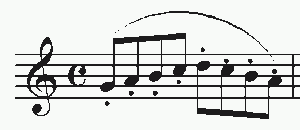 Non-legato consists of 2 important steps:
1. ‘Diving’ with the full weight of your arm and the relaxed, mobile wrist into the depth of the keyboard for achieving a beautiful, quality sound.
2. Lifting the hand from the keyboard after each note – first we lift the wrist and then the fingers. This step helps us to get rid of any tension that could have appeared while pressing the key, being also a good practice for wrist relaxation.
This way, non-legato is a quintessence of correct playing movements, being extremely useful for beginners. It is a proven solution against tension and muscle spasms – dark dangerous pits for all the ‘fresh’ piano students who attempt to play complicated pieces before their technique is ready for it.
 After learning how to play non-legato and control the quality of the sound, we can gradually learn legato. Beware the main trap, however – the same old tension. It’s very ‘easy’ to play with tensed, unmoving wrists while practicing legato. In order to avoid this trap, focus on wrist flexibility – imagine that it ‘anticipates’ the ‘layout’ of the melody by guiding the hand and moving it in the needed direction horizontally.
 Only after mastering a good level of free, flowing, tensionless legato we can move to learning staccato. Don’t spend too much time practicing it, though – staccato is not that difficult to play. There are different types of staccato – involving the fingers, the movement of the wrist or the entire arm. The exact form depends on the character of the performed piece or passage. I usually tell my students to imagine a cat playing with a toy on a string – her paws are soft and flexible, but the claws are always sharp and ready for action! Staccato is the same – the short, playful sound is achieved by ‘clawing’ at the keyboard as if the surface is at the same time attracting the fingers and burning them.
If learned too soon (before the correct non-legato technique becomes a natural reflex), staccato can seriously jeopardize the quality of your sound, making it superficial and affecting the ‘breathing’ of the wrist.
Actually, this is the most important thing, the ‘red line’ that unifies all forms of articulation and one of the main pillars of professional piano playing: your wrist should ALWAYS be flexible, no matter if you play non-legato, legato or staccato. A ‘petrified’, ‘crystallized’, immobile wrist is the core of most piano related problems: a harsh (or superficial) mechanical sound, tension (and its consequences – muscle pain and hand injuries), and, of course, the impossibility to progress and play complicated pieces and passages.
So, never forget to breathe – literally, by taking a deep breath and allowing it to relax and fortify your body and oxygenate your brain… and metaphorically, by relaxing your wrist each time your play non-legato or staccato… and by keeping a flowing, tensionless movement of the wrist while playing legato. This technique, combined with constant mindful practice, is the key to continual progress and fulfilling results.
Update (2021): this article is quite old! 🙂 I wrote it back in 2010, before recording my first video tutorials (and 2 years before launching PianoCareerAcademy). Now all the principles explained above are demonstrated in video form in the detailed step-by-step Courses and stand-alone tutorials that you can find in the Members Area. You can also find many free sample tutorials here on PianoCareer.com (and on my YouTube channel).
_________
If you enjoyed this free online piano tutorial, here are some other piano learning and practice topics you’ll like:
Chopin – Impromptu No. 1 in Ab Major, op. 29. Piano Tutorial.
The Life-Changing Benefits of Learning Classical Music.
Take a deep breath – relax your wrist
Why I sometimes ‘stray’ from the musical text in my tutorials: a holistic investigation
No piano? How to practice anywhere
Between pianissimo and fortissimo – improving the piano dynamic range
staccato piano, piano staccato technique, legato and staccato, wrist staccato, staccato and legato, what is staccato, piano staccato, staccato vs legato, legato staccato, staccato legato, staccato piano technique, how to play staccato on piano, legato vs staccato, how to play staccato, how to play staccato piano, staccato in piano