The piano sound is not born when the hammer hits the string. Just like our thoughts and emotions, the sound is a form of energy. First it is immaterial, originating in our mind and in our soul. Then it flows through our back, our shoulders, our elbows, forearms and wrists. The fingers transfer this energy from our mind and body to the instrument.
This way, the piano is only the ‘intermediary’ that materializes the sound, not its source.
Let’s quote Heinrich Neuhaus: “Music lives within us, in our brain, in our consciousness; its ‘domicile’ can be accurately established: it is our hearing.” Even if said with different words, the meaning is quite the same. You can’t hope to have a quality sound and a meaningful performance without imagining and hearing the result first in your mind and only then transferring it to the instrument.
However, today I want to share with you a practical aspect of this process – the tight relation between our posture at the piano and the sound energy.
In yoga, martial arts and other ancient holistic systems the energy is a key element. By learning how to feel and control our energy flow we can achieve wonderful results in all the aspects of our life: psychological and physical health, beauty, relationships, career and success.
Piano playing is not an exception. The fact that the hammerklavier is a rather modern instrument should not stop us from applying in our practice natural universal solutions tested throughout millennia.
When it comes to energy, the main thing we want to avoid is an energy blockage. If the natural, free flow of energy is disrupted somewhere in your body, it will eventually cause different dysfunctions and diseases. In terms of piano playing, there are two ways of creating a blockage or an energy jam: psychological and physical. The psychological one is harder to remove, being a result of anxiety, stress and insecurity. The physical one (besides being directly linked to our state of mind) is the result of an incorrect posture and tensed muscles.
In order to explain how the energy works in case of piano playing, let’s analyze the main aspects of a correct posture which will facilitate a free circulation of the sound energy. Of course, it all starts with an open mind. It will allow you to ‘hear’ with your inner ear the result you want to achieve: the character of the music, its content, its emotional intensity, the tempo, the dynamics and so on. I’ll write more about the power of imagination in the future, but now let’s concentrate on the piano posture and its effects on the quality of the sound.
 The back should always be straight, giving the pianist dignity and self-confidence. It has been proven long ago that our posture has a direct influence on our state of mind. A straight spinal column denotes strength, verticality, freedom and certainty. Slouching is synonym to weakness, insecurity, sadness and low levels of energy. A curved spine is also directly impeding the sound energy from flowing freely in our shoulders and arms.
The shoulders should be relaxed, having a natural tense-free position. There are many pianists who unconsciously raise their shoulders during performance, especially if they play a difficult piece. That’s why when we practice we should be aware of our correct posture so it will become our second nature. If your shoulders are raised, the energy won’t be able to reach your arms and wrists and the sound will lack depth and expression.

An incorrect elbow position
We should also be mindful of the position of our elbows. If we keep them too close to our body, straining them in a fixed position (as shown in the picture), this tension will also reflect on the quality of the sound. I usually tell my students not to lose their sound ‘on the way’ – in their shoulders, elbows or wrists.
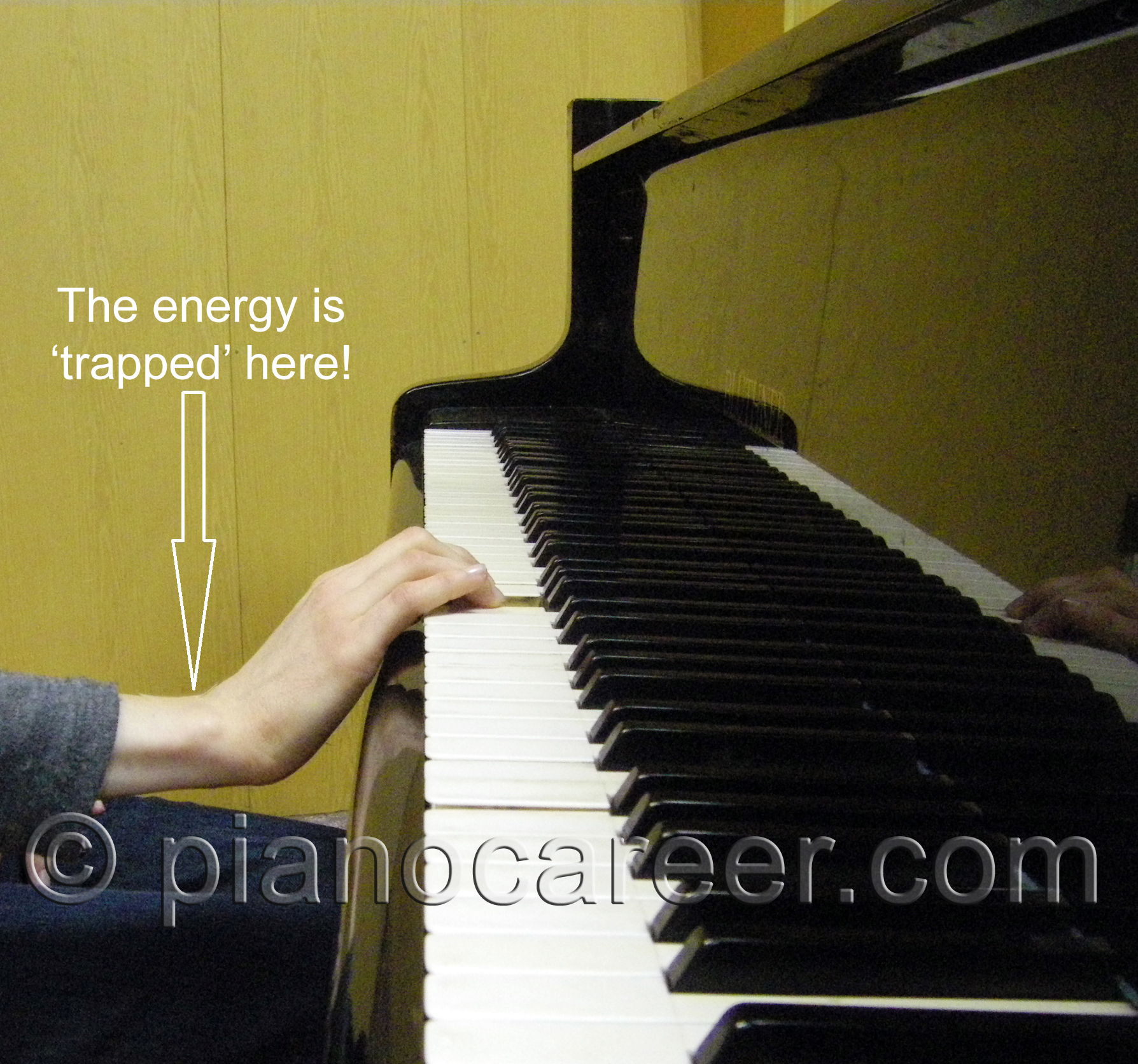
The wrist is probably the most important element of the pianistic apparatus. This doesn’t mean that your back, shoulders and forearms are less important. The wrist, however, is the main key to a beautiful, deep sound. My teacher used to tell me: ‘Don’t forget to breathe! Relax your wrist!’. She used to compare a pianist’s wrist with the breathing process.
An incorrect wrist posture
When the wrists are tensed, immobile, ‘petrified’, or if they have an incorrect position, the music doesn’t receive enough ‘air’, lacking a natural, expressive flow. When the wrists are relaxed, moving freely and ‘guiding’ the phrase, ‘drawing’ the relief of a musical theme (it’s the classical principle of ‘singing’ at the piano employed in the Russian piano school), the music breathes deeply.
Only if our wrists are relaxed and mobile, the sound energy will naturally transfer to the fingers and into the depth of the keyboard.
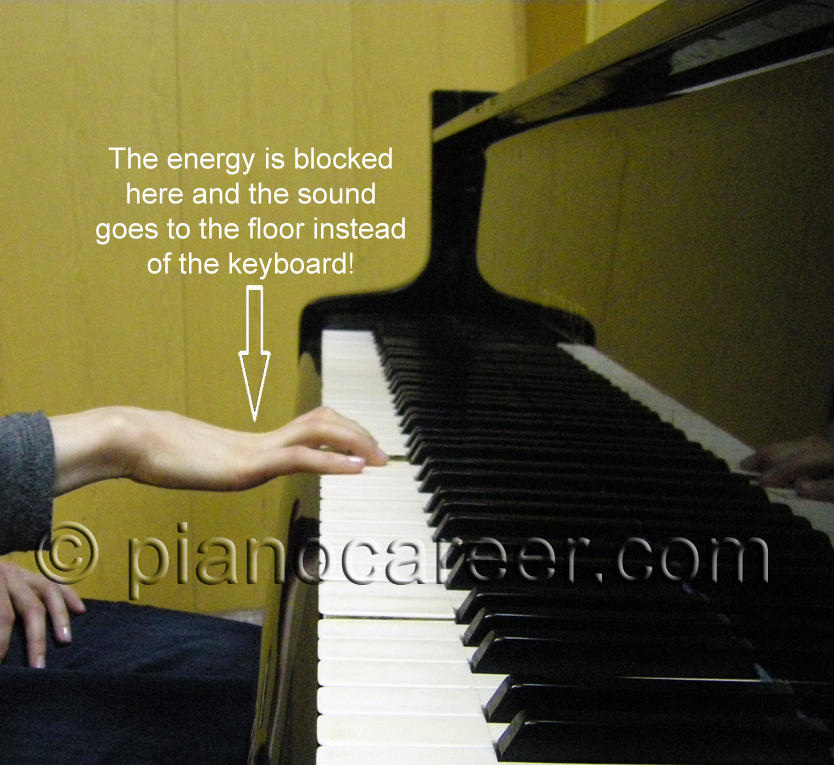 The hands should be ‘rounded’, with the knuckles forming a dome. Little children understand easier the correct hand position if they’re told to imagine that they are holding an apple or a tennis ball. If the knuckles are below the level of the fingers (as shown in the picture), it will severely affect the quality of your sound. Even when you play arpeggios, octaves and other ‘extensive’ techniques, you should still hold the dome and try not to ‘flatten’ it. With practice, the micro muscles of the hand will strengthen and this hand position will become natural and comfortable. The round shape of your hand is the best ergonomic solution which allows the sound energy to be transferred from the wrists to your fingers and into the instrument.
Whenever the natural energy flow encounters an obstacle (a strain or tension in your back, shoulders, elbows or wrists), it will have a detrimental effect on your sound. Such a ‘crippled’ sound is either too loud and brutal, either too superficial (‘ghost-like’, as I like to call it).
A true piano sound has to transcend the ‘hammering’ realities of the instrument, getting close to the cantability of the violin or the voice. It’s impossible to create such an acoustic illusion without mastering the correct posture and combining it with mindfulness and a good control of the energy flow.
Of course, it’s not easy to achieve such a high performance. It requires many years of practice and lots of hard work. It’s just like in martial arts – a novice has to practice thousands of times a kick or a punch before he will learn how to control his energy, thus bringing his mastery to a new level.
Which is the best way to remove these pianistic energy blockages?
Most piano teachers are perfectly aware of the crucial importance of a correct posture. However, it still remains a mystery why so many beginners are not being taught from their first piano lesson how to play correctly. Even if these students learn by heart all the notes, even if their sight-reading is getting better every day, even if their fingers are getting faster, allowing them to play more complicated pieces, they will never be able to become professional pianists if they don’t have a quality sound (as a result of a bad tensed posture). Correcting a bad playing habit is much harder than teaching step by step a good posture from the beginning!
However, if you’ve been practicing incorrectly for many years, thus experiencing not only ‘energy jams’ but also muscle pain and tension, you should work towards gradually correcting your playing habit.
Correcting the piano posture is not an easy job – imagine that you have to learn again how to walk or talk. Still, the sooner you start this hard process, the sooner you’ll be able to take advantage of the unlimited possibilities that a correct posture can offer us.
Whenever you sit at the piano, remember to relax first, and then start playing. No matter what you play – scales, exercises, etudes, lyric or virtuosity pieces – never forget about the freedom in your mind and your muscles. Don’t play mechanically – automatic playing is the worst enemy of meaning and expression!
Even when the piece you’re practicing is extremely difficult and it seems impossible to play certain passages with a relaxed hand, don’t give up. Play very slowly at first, monitoring all your sensations, until it becomes comfortable to execute the given fragment without any stress. When you’ll gradually increase the tempo, you’ll notice that the tension disappears step by step. Never keep your hands fixed and immobile – they should always be in a flowing motion. Don’t exaggerate though – piano playing is not a hand ballet! All the movements of your elbows, forearms and wrists should be natural, relaxed, expressing the meaning of the music. This method is also a good way of healing and preventing any hand injuries and muscle pain.
The energy flow in our arms is like the waters of a river, and the piano is the sea. How can the water reach the sea if we build artificial barriers?
If you enjoyed this free online piano lesson, here are some other piano learning and practice topics you’ll like:
Studying Piano – How to Cope With Exams? 7 Basic Steps
Between Pianissimo and Fortissimo. Improving the Piano Dynamic Range.
No Time to Practice? 5 Powerful Solutions for Lack of Time
The Secrets of a Correct Piano Key Attack
Constructive Tip for Piano Beginners – Avoid Staccato!
Work Smart! Tips for a Productive and Enjoyable Piano Practice
The 5 Basic Elements of a Correct Piano Posture
Understanding a Piano Piece: 11 Basic Steps
The life-changing benefits of learning classical music
Wrist, arm and shoulder warm-ups for piano players
No piano? How to practice anywhere
Why I sometimes ‘stray’ from the musical text in my tutorials: a holistic investigation
piano posture, playing the piano is what type of energy, what energy is formed when you play the piano, piano energy, piano hand posture, what type of energy is a piano, what type of energy is playing the piano, what energy is form when you play the piano, a piano is a good source of energy, energy piano, what kind of energy is playing the piano, piano energy transformation, what energy is playing the piano, what type of energy does a piano use, playing the piano energy transformation, what energy does a piano use, playing a piano is what type of energy, piano sound, what energy is formed when you play the piano?, piano elbow position, what type of energy does a piano use to produce sound, the sound of piano, high energy piano, a piano is a good source of blank energy, bad piano posture