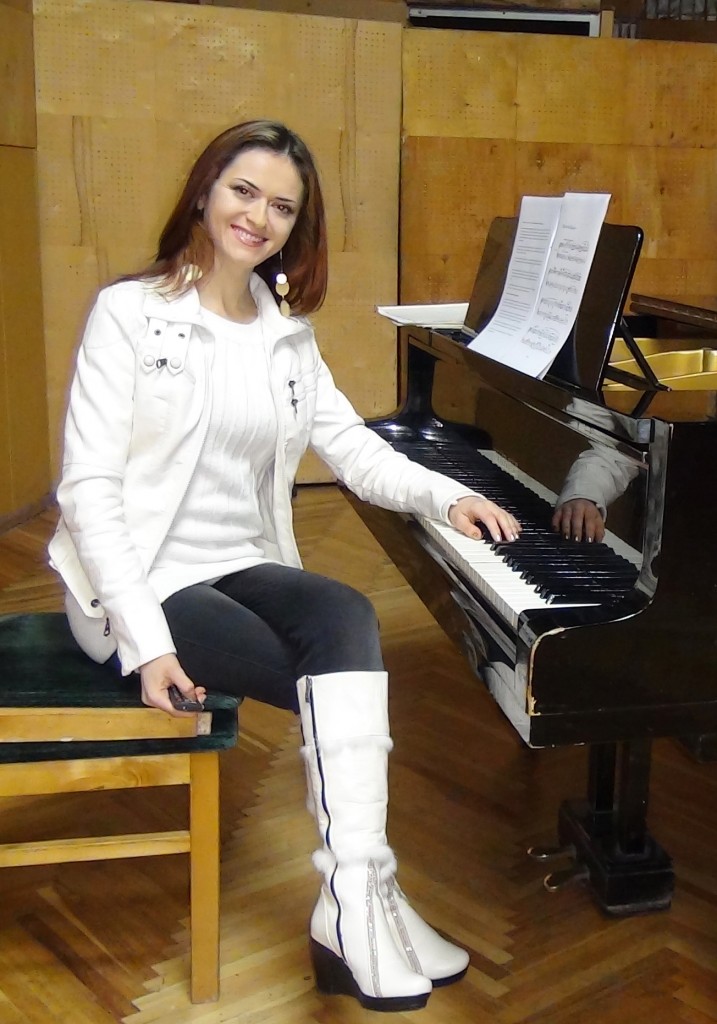
 The art of piano pedaling is not an exact subject: it cannot be measured or divided into scientific categories.
As I told you in my previous tutorial – there is no such thing as a ‘correct’ pedaling. What is ‘correct’ for Bach is certainly ‘incorrect’ for Chopin! What is ‘correct’ for the Viennese classics (Haydn, Mozart and Beethoven) is certainly ‘incorrect’ for Debussy or for the expressionist music of the XXth century!
The basic pedaling techniques which I showed you in the first part of my pedal tutorial (for example the delayed pedal or the simultaneous pedal) can be used in thousands on different ways.
So how can we be sure that our pedaling is musically appropriate?
The use of the pedals in a certain piece depends on many ‘variables’. Some of these variables are subjective and difficult to explain: talent, creativity, inspiration, hearing. Others are a little more objective – for example the harmonic structure of the piece, the meaning and the ‘layout’ of a certain phrase or motif, the character of the music and the style of the composer.
Just as I promised in my previous article – this tutorial will be dedicated to the art of using the pedals depending on the style of the composer. In the second part of the article I’ll also describe the basics of pedal notation.
Enjoy the video! I know I had a great time making it, even if I had no time to practice all the fragments I play as examples :).
Nowadays there is a lot of controversy among pianists about when and how we should use the pedals.
Some pianists like to follow certain strict pedaling rules. For example, there are piano teachers who consider that we should play Bach, Haydn and Mozart without pedal, simply because they wrote their works for the harpsichord (and not for the modern piano). Some prefer a rich pedaling, while others like the austere sonority of a ‘dry’, ‘economic’ one – and the list can go on!
Music is a subjective art and so is piano playing. Everyone is entitled to their opinion – and I think that diversity is certainly a good thing! It allows us to explore all the facets of the wonderful piano pieces we’re playing.
That’s why I’m not writing this article for saying who’s right and who’s wrong. I simply want to share with you the pedaling guidelines we use in the Russian piano school, and also the main pedaling tricks and secrets I use on a daily basis, also recommending them to my students.
In my fist pedaling tutorial Using the Piano Pedals – The Art Behind the Mechanism I showed you the functions of the piano pedals and the main pedaling techniques. We all need to master these techniques, but we should also know when and how to use them.
Here is when the ability to understand musical styles comes to our rescue. By learning the main ‘characteristics’ of each musical style, by distinguishing the ‘colors’ and ‘textures’ of each musical epoch, you’ll be able to apply the most suitable pedaling techniques. First, it will be a question of adapting your pedaling to your theoretical knowledge. In time, however, this process will become intuitive and extremely comfortable.
Using the Pedals in Playing Baroque Music
1. The music written for the harpsichord and the organ should be played WITH pedal on the piano. Why? Here are the reasons:
- The harpsichord didn’t have dampers and its strings could resonate longer than the strings of the piano; for achieving the same effect on the piano and avoiding a ‘dry’ sonority, we need to use the sustain pedal.
- The powerful and deep sonority of the organ remains on the same level for as long as we keep the keys pressed; it’s impossible to play organ works on the piano without using both the sustain and the soft pedals. The sustain pedal helps us to create a better continuity and a deeper, more powerful sonority, while the soft pedal allows us to change the color of the sound (imitating a switch of the organ registers) and to make it more distant.
2. The sustain pedal has to be used carefully, especially in polyphonic pieces. We have to avoid ‘blurring’ the melodic line or ‘gluing’ together incompatible sounds or harmonies. We need to use the pedal only in certain places, for creating certain effects – for example making a better legato or emphasizing a specific harmony, rhythmical structure or articulation mark.
3. The pedal should be changed often and we need to make good use of the ‘half’ pedaling technique :).
4. We can also use the middle (sostenuto) pedal, especially in playing Bach’s organ works. It can help us to sustain only certain notes (for example the bass), at the same time keeping all the other voices as detached and transparent as possible.
Using the Pedals in Playing Classical Music
1. The French harpsichordists (Lully, Couperin, Rameau etc.), Haydn and Mozart. In playing the music written by these composers, we should use the pedal sparingly, in a smart manner, only in certain places – depending on the character and the meaning of the music.
2. Classical music is the reign of logic, balance and harmony – that’s why our sonority has to be clear, transparent and luminous. Using too much pedal (or not changing it as often as necessary) can make classical pieces sound too heavy and stylistically inappropriate.
3. Beethoven was the first composer who used the pedals actively in his playing AND writing. However, we should remember that there was an amazing evolution in his style – and we have to use the pedals according to these stylistic changes:
- his early works remind us of Haydn and Mozart’s style – and the use of the sustain pedal should be reduced to a necessary minimum – only for emphasizing certain effects or ‘amplifying’ the resonating properties of the instrument when needed.
- his late works make the transition between the classical and the romantic eras, and the use of the pedals should be modified accordingly: we can use more often the delayed pedaling technique and other thick, rich pedaling effects – they will help us to create dramatic contrasts and bright colors (which are characteristic for Beethoven’s late works).
- Beethoven had an orchestral thinking. Some researchers say that he used his piano Sonatas as a ‘research lab’ for creating his symphonies. In his piano works, the pedal has not only a sustain function, but also the role of making the piano sound as an entire symphony orchestra!
- Beethoven also used the soft pedal, writing una corda in the score each time the use of the left pedal was needed for changing the timbre of the sound and making it softer.
Using the Pedals in Playing Romantic Music
1. The romantic piano music cannot be played without pedal. Romantic composers (Schubert, Mendelssohn, Chopin, Schumann, Liszt, Franck, Brahms, Grieg) wrote their piano works for the hammerklavier (the modern piano with a hammer/string/damper mechanism and 2-3 pedals), creating the structure of their pieces according to the ‘upgraded’ capacities of the new instrument :).
2. The romantic piano pieces have a wide structure that comprises the entire keyboard (as compared to the compact structure of the classical works). All the pianistic innovations of this epoch were made possible, first of all, by the invention of the sustain pedal. By allowing the strings to vibrate even after the pianist has released the keys, this pedal helped romantic composers to create a new type of piano technique: arpeggios that cover the entire keyboard, wide jumps, a rich harmonic sonority with a large diapason – it’s impossible to connect these wide structures without using the sustain pedal!
3. The sustain pedal is extremely important in playing romantic pieces with a lyrical character. By using the delayed pedaling technique, we can improve our phrasing, make a better legato and enrich the sonority of the piece – this way making the piano SING.
4. Sometimes, we can play several bars without changing the pedal (for example, the beginning of Chopin’s Nocturne op. 27 in D flat Major which I play in the video) – of course, with the condition that the harmonic ‘background’ remains the same (in our case – D flat Major). For using such a pedal the melody needs to be very deep and expressive, ‘hovering’ above the accompaniment provided by the left hand. Otherwise, if the melody is not played considerably brighter and deeper than the left hand, it is dangerous to play all these bars on the same pedal – we risk creating a dirty sonority!
5. The romantic music is extremely diverse and multilateral: different characters and emotions (lyrical, dancing, tragic, sarcastic, dramatic, heroic, serene, picturesque, divine and demonic, feminine and masculine) are fighting, peacefully alternating or intertwining – many times in the same piece or fragment – for creating musical images of an amazing emotional power. The use of the pedal should always be subordinate to the character of the played fragment: we should use not only the ‘traditional’ delayed pedal, but also short simultaneous pedals, half pedals, quarter pedals, fluttering pedals and so on!
Using the Pedals in Playing Impressionist Music
1. Musical impressionism was inspired from the subtle game of shadows and blurred colors used by impressionist painters – Monet, Renoir, Pissaro etc. Impressionism is about reflecting the general impression ‘imprinted’ in our mind (or in our emotions) by a certain image, event or character. It appeared as a reaction to the romantic style, replacing obvious musical images with subtle suggestions.
2. Debussy and Ravel created a totally new pianistic structure, inventing new colors of the sound and new uses for the piano pedals. However, you should keep in mind that their music was inspired not only from the art of the impressionist painters. We can find the roots of their stylistic innovations in the works of the French harpsichordists of the XVIII century.
3. The use of the pedals should be subordinate to this interesting ‘symbiosis’ between the exact, accurate sonority (inspired from the harpsichord music) and the blurred, slightly dissonant one (inspired from the impressionist paintings). Debussy and Ravel use all the 3 pedals in their works (many times in unusual combinations) for achieving extremely original effects.
Using the Pedals in Playing the Music of the XXth Century
1. The XXth century was the era of stylistic experiments: atonal and expressionist music on one side, neoclassical on the other, not to mention the neo-romantic tendencies and so on!
2. In playing experimental music, our main pedaling guide is the score. Modern composers usually indicate exactly when and how we should use the pedals and what ‘sound effects’ we should achieve. And, of course, we can always experiment when playing modern music! 😉
Short Conclusion
As a conclusion, I will say that starting with Beethoven, all composers used the pedals in writing their piano works. BUT we need to use the pedals in playing baroque and classical music as well, for emphasizing certain characters, for making a better legato, for enriching the sonority and changing the timbre of our instrument.
Of course, the above pedaling guidelines cannot cover the amazing complexity of the entire pianistic repertoire. They are only general road directions that will hopefully help you have a better understanding of this subject and trigger your curiosity for learning more about the particularities of each musical style.
And a bonus pedaling tip: we all know that each rule has its exceptions. However, let’s concentrate a little on a simple yet very useful rule: always analyze the harmonic ‘skeleton’ of the piece you’re playing! Usually, the use of the sustain pedal is determined by the harmonic structure of the piece – especially in classical and romantic works. By assimilating this simple rule, it will be easier for you to deal with the baroque, impressionist and atonal exceptions! 😉
Now we have finally reached the last part of my pedaling tutorial – pedal notation! Fortunately, this is a very easy topic, so I’ll try to make it very short :).
Sustain Pedal Marks
1. Traditional sustain pedal marks:
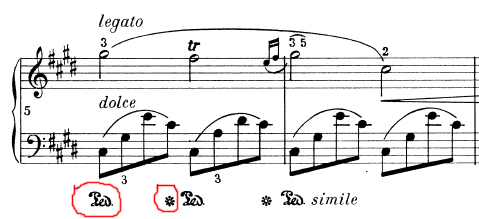
Engage pedal – Ped
Release pedal – *
2. Modern schematic marks (for example ____/\___|)
This pattern is meant to ‘show’ you how and when to engage and release the pedal.
- Horizontal lines symbolize a depressed pedal;
- Diagonal lines indicate a change of the pedal (or a temporary release);
- Vertical lines indicate where we should release the pedal.
While these patterns seem extremely convenient, personally I prefer the ‘warmer’ design of the traditional marks :).
Soft Pedal Marks
Engage pedal – una corda;
Release pedal – tre corde.
However, be aware that the use of the soft pedal is not always indicated in the score, especially in the works of baroque and classical composers (sometimes in romantic music as well). So never forget to keep your hearing sharp and your imagination ‘tuned’ – they will tell you when the use of this pedal is required by the musical content.
Sostenuto Pedal Marks
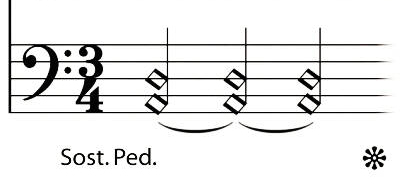
Engage pedal – Sost. Ped.
Release pedal – *
The middle pedal is rarely used, that’s why you may encounter other pedal marks – for example giving the notes which have to be sustained with this pedal a hollow, diamond-shaped ‘design’.
And a bonus pedal notation tip: no matter how sophisticated the pedal marks in your score are, they still can’t fully reflect all the details of an inspired, musically appropriate pedaling. That’s why you don’t have to follow the pedal indications exactly (especially when playing baroque, classical and romantic music). Simply trust your sense of style and your hearing and don’t allow the sonority to become dirty, cluttered with dissonant sounds.
In the end of this loooooong 2-part tutorial, I will say again that achieving a ‘perfect pedaling’ is not our purpose :). Our purpose is enjoying what we do, exploring the amazing pianistic repertoire and sharing it with our friends/audience and, of course, improving our pianistic skills so we could send the message of the performed pieces as best as possible! An appropriate use of the pedals is simply a means to this end!
P.S. If you’re practicing a certain piece and you’re not sure if you’re using the appropriate pedaling – share your dilemma in the comment form below! 😉
Don’t miss my next tutorials – follow PianoCareer.com on Facebook, Twitter and Google +!
If you enjoyed this free online piano lesson, here are some other piano learning and practice topics you’ll like:
Understanding a Piano Piece: 11 Basic Steps
How to Use the Sustain Pedal Correctly: The Bio-Mechanics of a Healthy Piano Pedaling Technique
The life-changing benefits of learning classical music
Why I sometimes ‘stray’ from the musical text in my tutorials: a holistic investigation
No piano? How to practice anywhere
piano pedal notation, pedal symbol piano, pedal markings piano, piano pedal symbol, pedal simile, pedal notation piano, piano pedal markings, pedal sign, pedal markings in piano music, piano notation, piano symbols, pedal symbol, pedal markings, sheet music pedal notation, sustain pedal symbol, sustain pedal notation, pedal sign in piano, piano pedal symbols, pedal notation, what do the foot pedals on a piano do, piano sheet music pedal notation, with pedal piano notation, piano pedal sign, pedal sign piano, damper pedal symbol
Thank you so much for your hard work. A fantastic tutorial!
(by the way: great boots!)
Thank you, Elwyn! 😉
Hi Ilinca,
Very comprehensive and inspiring; it was especially wonderful to actually see you play snippets of some beautiful pieces—wish there was time to hear a full concert by you!
I never realized that there were different pedaling styles depending on the era of the piece being played, although I had read the controversy over “to pedal or not to pedal” J.S. Bach, etc… It will make me consider more thoughtfully the use of the pedal in the pieces I play. You have made me aware of half-pedaling and simultaneous pedaling techniques, to name only a couple.
By the way, you played the beginning of Debussy’s Claire de Lune in this tutorial. My father who was a professional pianist and loved Debussy and Ravel, before he died, told me that, if nothing else, I should learn to play this piece well. So, I learned the notes, memorized it, and have had it “up my sleeve” to play when I want to “be” with him. (I wasn’t able to learn it before he passed away…) So this music is especially important to me, not to mention so lovely. Although, I cannot say I play it well yet! The long arpeggios in the LH after the introduction of the theme in the beginning are particularly tricky. I always manage to slip/miss the black keys… And, there are many other “new” ideas that I need to apply that you have taught me (phrasing, pedaling, more relaxed fingering and arms). Will revisit this piece. In terms of pedaling this piece, I’ve been experimenting lately on use the soft pedal too in some parts, and I’ve read that much of Debussy’s pieces can have a more blurred ethereal sound. So, I have to admit, I have become confused about pedaling Claire de Lune. What is your opinion about this particular piece of music? Do you use the soft pedal at all in certain parts (such as the gentle beginning, or the fading finale)?
Great to “see” you again in the tutorial! Thank you for all your effort to share your mastery. Ilinca, I cannot tell you how much you have inspired my playing. My path ahead is still long, but I feel these past months that I have definitely improved! (btw, played Schumann’s Fast ZuErnst No.10 at last week’s lesson and my teacher sat silent afterwards for a minute—I thought she was organizing her thoughts for critiquing me—but she finally simply said, “wonderful!”. I feel I have you to thank; your earlier advice really helped me with phrasing and bringing out the “silver line” of melody.
And, just a comment on your reply to another person you wrote from before, about how playing for one’s teacher is, among other things, one’s first presentation to someone (I forget your exact words…) and is a significant opportunity to play for an audience, albeit one person. Anyway, your comment really has stuck in my head; I never really thought about it that way, but it explains my sudden nervousness when playing for my teacher at the start of a lesson, or presenting a new piece for her to judge. It seems so obvious now, but I always thought I was just feeling insecure (which is not typically a trait that I have, eg. public speaking for me is not a problem!)
Hope you are keeping warm and enjoying each day! Thank you as always.
Hi Alexandra!
Thank you for your comment! 🙂
Initially, I was planning to write only an article on this subject – using the pedals depending on the style of the composer. However, when I began writing the article, I realized that I have to make a video as well and demonstrate at least some fragments of each major musical style. Well, that was definitely an enjoyable experience for me – and I’m really happy that you liked it!
Thank you for sharing with us your personal experience with Debussy’s “Clair de Lune”! It’s great to know that your father was a professional pianist and this piece helps you to feel closer to him.
Personally, I never learned this piece, probably because the lack of time (I was sight-reading it in the video). I decided to play it in my tutorial because, first of all – it’s amazingly beautiful, and second – it illustrates extremely well the impressionist ‘combination’ between the sustain and the soft pedals. This combination helps us to create that blurred sonority with occasional accurate ‘highlights’ that is specific for this musical style.
So, yes – the soft pedal MUST be used in this piece – especially in the beginning (and every time the content requires a very soft, blurred sound). It will help us to create a soft, distant, ‘otherworldly’ sonority – an ‘impression’ of the cold yet comforting moonlight, which transforms everything into a scene from a fairytale and gives every object mystical ‘contours’.
At first, this ‘diffuse light’ is forming from the melody itself – it should be played with a typical ‘dreamy’ Debussy sonority, but without losing the layout of the theme. Then, when the arpeggios in the left hand begin, we should create the illusion that the moonlight suddenly becomes more intense – as if the wind is softly ‘chasing’ some clouds – they alternatively cover the moon and then allow it to shine. Of course, in this fragment the melody should ‘shine’ and ‘hover’ above the ‘cloudy’ background of the left hand. This fragment can be played without the left pedal, and we have to make sure that the left hand remains soft and ‘dreamy’, creating a fantastic atmosphere which should remind us of mythological creatures and mysteries (I don’t know how else to explain this effect!).
Wow, I’m so happy to hear that your teacher told you that you have played Schumann’s piece ‘wonderfully’!!! Yes, usually our teacher is our first audience, being in the ‘middle of the road’ between playing alone and playing for an audience. So, each time we play for our teacher, we are in fact practicing for playing on stage :).
Have an inspired practice and good luck with “Clair de Lune” and Schumann’s Suite! And thank you again for this wonderful comment!
Ilinca
Hi Ilinca
Wow! Thank you very much for a wonderful and an awe-inspiring video tutorial. I never imagined that my question about pedalling would be so time consuming and involve so much hard work for you. I hope you have enjoyed making the videos too. It is lovely to see you and to hear you – whether talking, or playing.
Like Alexandra, I didn’t know that there were different pedalling styles, depending upon the era of the piece being played and on the individual composer. As I develop my playing, I’ll be able to think about the different uses of the pedals. That in turn will help me to understand and to apply what I have learned from your tutorials; thereby increasing my knowledge and creativity. The three tutorials will be invaluable and wholly beneficial to me. Thank you.
Keep well and have a happy week.
Pauline
Hi Pauline!
Thank you for your comment and, of course, for inspiring me to create these tutorials! 😉
Yes, I really enjoyed making this video and I’m really happy that you liked it! I would have published it earlier, but I couldn’t find the time to write the article which goes with it, so last week I finally found a couple of hours to put the entire tutorial together – and it feels really good! 🙂
Yes, pedaling depends directly on the musical era when the piece was written. As I explain in my article, our instrument has passed through many changes in order to reach the form we are familiar with today. The evolution of the instrument’s construction influenced directly the structure of the pieces – the keyboard diapason, the quality of the key attack and, of course – the use of the pedals.
At the same time, we should not forget that music is always reflecting the present, that it is ‘alive’ (and not a form of ‘conserved’ artifact) and that it should be adapted to the realities of our time – to the rhythm and the atmosphere of our epoch. This way, we have to create a natural symbiosis between the old and the new, between tradition and innovation.
I’m really glad that my tutorials helped you to discover new things about piano playing! 🙂
Have a wonderful week as well and a very enjoyable practice!
Ilinca
Absolutely superb video, Ilinca! Very energic and clear explanation.
I learned a lot again and it’s great to watch it more than once…
Thank you very much for all the time you spend on making these great video lessons 🙂
All the best,
Many greetings from Holland!
Joost
Hi Joost!
Thank you for your comment!
I’m really glad you enjoyed my tutorial! 😉
Good luck with your project as well!
Ilinca
hi ilinca
amazing video, i never really knew there were so many differences between composers. The pieces you played were remarkable, and i just wanted to ask which piece you played at the very beginning of the video; it sounds truly incredible and you played it effortlessly.
thanks so much for the videos as they really help me to understand and give me great insight into classical music.
Hi Billy!
Thank you! 😉
In the beginning of the video I play a fragment from the amazing Chromatic Fantasy by Johann Sebastian Bach.
By the way, you can click here and find out more about my current project – an exclusive Piano Coaching Program where every member can ask any piano question and receive personalized, detailed, professional advice! 😉
Have a wonderful day and enjoy your practice!
Ilinca
Hi Ilinca,
Thank you so much on your tutorial on pedaling. It was very useful, especially as I am prepraring for my Dpiloma exam- and I don’t have a piano teacher.
One of my exam pieces is Schubert’s Impromptu in F Minor Op 142 no 1.
I have a couple of questions on use of pedals in this piece and would be grateful for any help
1. In the “A ” section, how much sustained pedal is appropriate? My edition does not give any pedal notations for this section
2. In the “B” and “B1” sections,( this is where I have a problem!) I am practicing by keeping the soft pedal down throughout most of the section as it is mostly pp, except where there are short passages for forte. Is this appropriate? I am worried that extensive use of the soft pedal in these two sections may be construed as an inability to play pp without the pedal by the examiner. I tried playing these sections without the soft pedal- but the sound is quite loud and I have to put in a lot of effort to keep the sound down- causing fatigue by the end of the piece.
Any guidance would be appreciated- thanks for your patience
Regards,
Veena
Hi Veena!
Thank you for your comment!
I’ll answer your question in a day or two – as soon as I find a little time ;). In February 2012 I launched a new project – PianoCareerAcademy.com (a Holistic Piano Coaching Program) which keeps me busy 24/7 – answering piano questions, recording video tutorials etc.
In the meantime, enjoy your practice and have a great weekend!
Ilinca
Hello Dear ILinka:
I love your site and I learn and use many good things from you from this way! 🙂
Thank you so much, I am searching for piano pedalling at my school (tehran university of art and music)… and I want to write in my reaserches about your teachings and talks… So I’d like to ask you if it’s possible please give me some sources to do it and to name it there! Do you use special sources for this or could you please inform me about some what is of course free!
I would be so greatfull
Thanks anyway 🙂
Hi Mahtab!
Thank you and welcome to PianoCareer.com! 😉
In my tutorials I share the principles of the Russian piano school. All my articles and videos are based on my own experience, being the result of almost 30 years of piano practice – and I learned everything I know directly from my teachers. I don’t have any published books (yet :D) – but you can certainly quote this site (PianoCareer.com) and my name (Ilinca Vartic) in your work.
Plus, don’t forget to subscribe to my email newsletter – this way you’ll get a free copy of my report (ebook) “A New Perspective on Piano Phrasing”.
Also, if you’re interested in reading more books dedicated to the secrets of the Russian piano school, I recommend beginning with Heinrich Neuhaus’s “The Art of Piano Playing” (by the way, there you’ll find an entire chapter about pedaling!).
And, of course, you can find hundreds of other tutorials (videos and articles) on my Piano Coaching Program at PianoCareerAcademy.com (but this is a paid membership program).
Good luck with your research and have a wonderful week! 🙂
Ilinca
Hi! I have a question.
My sheet music has Ped * markings. Every so often, they are in parentheses. Does this mean they are optional?
Also, near the end, there is a Ped without a *, and the music goes on for about 40 measures. Clearly I’m not supposed to hold them all. Does the Ped without a star mean I should continue the same pattern?
Hi Ichigo!
First of all, what exact piece are you playing? Different composers (and editors) have different ways of indicating the pedaling – and it also depends on the epoch, style and genre of the piece.
But generally – yes, (Ped *) means that this particular pedal is optional.
I also recommend to read this short tutorial – it covers the second half of your question ;).
Cheers,
Ilinca
Hi Ilinca,
I just now stumbled upon these articles (I was googling how to fix something on my piano) and I am very intrigued!
I haven’t had much specific teaching on how to use the pedal. I’ll have to say, I haven’t really minded that very much, but now that I’m getting into college level pieces, I’m starting to notice that it’s getting harder to make the pieces sound the way I would like them to. I suspect a large part of this is the fact that I don’t have an in-depth knowledge of how to use the pedal.
Right now, I am working on the second movement of Ravel’s piano concerto in G major. It is a beautiful piece, but it is also very confusing when it comes to pedaling. Each part of the piece has it’s own challenge with regards to using the pedal. In the beginning especially, since the melody is in three, and the left hand is in two, I’m not really sure how to keep the melody clear while giving an accent to the bass note of each triplet. In the second part of the piece, with a new melody, the melody reminds me a lot of Gershwin, and I interpret the melody as slightly detached, but again, I am not sure how to accomplish that while still keeping the bass line continuous. Finally in the last part, after the climax of the piece, I don’t know how to keep the right hand from getting blurred without making the left hand detached.
Thanks again for writing this article!
Hi Jonathan!
Thank you for your comment – I’m really happy that you enjoyed my pedaling tutorial! 😉
I would love to answer your question about Ravel’s concerto – but I currently dedicate 99% of my time to my Piano Coaching Program at PianoCareerAcademy.com – and there are simply not enough hours in a day for offering free individualized guidance as well. I certainly wish that would be possible!
One little tip: at all times when it comes to pedaling, your hearing should be your main guide! 😉
Cheers,
Ilinca
Hi, Ilinca!
It’s the first time I’m visiting your website, and I must say I love it!
I’m not a classical piano student. I began learning it by myself, and I’m currently taking piano lessons in a way that’s a little bit different from the usual…
My primary instrument is my voice – I’ve been learning and singing for almost 8 years now – , but I decided to learn the piano in order to become a better singer/songwriter. 🙂 I work within the pop/acoustic genre.
I’m commenting just to say thank you, as I’m currently working on a music sheet for a song in which I’m planning on using the una corda pedal, initially. 🙂
So,…. thank you very much for the great tutorial! And if you could please check out my website, I’d be very, very appreciated! I’d really like your opinion, even though it’s not the same genre! 😀
Hi Liane!
It’s great to meet you! 😉
You have a great website – and I LOVE your voice!!!
I would love to write more – but I have a very crazy work schedule and I must return to my students :).
I’m happy that you enjoyed this tutorial – and I wish you lots of good luck with all your future projects! 😉
Warmest,
Ilinca
Hi,
I would like some advice regarding how to pedal when there are scale passages/quickly-changing keys in succession. Eg, I want the melody to be legato (but am unable to do that with my fingers alone) but there are scales in the accompaniment part that can blur easily.
In this case, I need advice on the octaves part in the scherzo of Beethoven’s sonata op. 26. Also, shall I use a lot of pedalling in the last movement (which makes it all seem more powerful & less dry), or is it merely my fingers that can achieve that good effect?
Same with the octaves part in Tchaikovsky’s piano concerto, roughly page 7 (bottom line, in the Edition Peters score for two pianos – in case it is hard to find). I am completely out of ideas there, similar to several other quickly-changing harmonies & scale passages in other pieces.
Hi Clara!
This is Natalia, Ilinca Vartic’s assistant at PianoCareerAcademy.com.
Ilinca would love to write an answer to your question – but every minute of her schedule is already fully booked. She dedicates her entire time to her Piano Coaching Program at PianoCareerAcademy.com (where we currently have more than 300 members) – and unfortunately it’s physically impossible for her to offer free individualized guidance as well (by giving detailed replies to all the emails/comments she receives on a daily basis). She certainly wishes she could! 🙁
So the only way Ilinca can help you in your piano quest is through her Piano Coaching Program – where you can find hundreds of piano playing tutorials that share the professional principles of the Russian piano school :). The tutorials are focused on an extremely wide range of piano topics:
– posture and key attack,
– sound and expression,
– technique (including step-by-step Scale Tutorials),
– teaching,
– correct practice,
– performance,
– repertoire (including lots of downloadable scores, method books and other useful resources),
– pedaling,
– detailed practice recommendations for specific pieces,
– step-by-step Lessons for Beginners,
– health, motivation etc.
Moreover, once you join you will also have access to an enormous library of downloadable materials that we use in the Russian piano school (method books, graded repertoire books, scale charts – and much more!).
Shortly, the membership includes:
– 24/7 access to ALL our hundreds of video and written tutorials;
– Access to our step-by-step courses (the Lessons for Beginners, the Scale Lessons);
– New tutorials every week;
– Downloadable scores and method books (including unique materials we use in the Russian piano school);
– Thousands of captivating piano conversations with piano students/teachers/enthusiasts from the entire world;
– The possibility to submit recordings in our MasterClass and receive detailed feedback from Ilinca;
– The possibility to chat with other members of our big community, to share your recordings and your piano progress with them;
– Piano motivation, inspiration, health advice;
– … and much much more!
Even if at the moment Ilinca’s schedule does not allow her to offer free individual piano guidance, she is still doing her best to maintain a very low registration fee for her Piano Coaching Program. The membership prices are symbolic (as compared to the cost of piano lessons nowadays), but the benefits are incomparably higher: for the price of a 30 minute lesson ($47), you have unlimited access to all the resources of our forum for one MONTH, discovering exclusive information that it’s impossible to find elsewhere.
If you have other questions about the functionality of PianoCareerAcademy.com, don’t hesitate to ask – by sending me an email at pianocareeracademy at gmail.com!
—
Sincerely,
Natalia
Customer Support
PianoCareerAcademy.com
Hi Illinca
Any thoughts on correct pedalling technique for the introduction of Mozart’s Fantasia in D minor.
To take the first beat there is the triplet motif which then leads to Octave D
I rather think that the correct pedalling is to pedal the triplet releasing the pedal on its last note and use the delayed pedal technique for the octave D but the pedalling for the remainder of the bar (and the other similar bars) appears problematic.
Maybe I should be thinking in terms of finger legato but this intro needs colour to retain it’s somewhat sad character – which persists up to the D major section.
Any advice would be appreciated.
Regards
Eric
Hi Eric!
This is Natalia, Ilinca Vartic’s assistant at PianoCareerAcademy.com.
Please read my answer to the question above :).
—
Sincerely,
Natalia
Customer Support
PianoCareerAcademy.com
Hi Ilinca,
Please help me to feel less like an idiot– My wife is a classically trained pianist who can sight-read wonderfully and can play pretty much anything you put in front of her. She expressed an interest in some of the songs from Mary Poppins for one of her classes, so I decided to go one better, and for Christmas I bought her the complete score, an original 1964 book that I found on eBay. Only I realized too late that it’s an ORGAN score, written with 1 treble clef and 2 bass clef lines under it! My question is, will she still be able to play this (and have it sound good), or did I totally blow it? I just want to know what to say (or not to say) when she opens it and sees it’s written for organ. It’s a great book– Lots of photos, stories and behind-the-scenes trivia, so I’m sure she’ll enjoy it for those aspects– I was just excited (obviously) for her to be able to play the music as well! Thanks for any light you can shed on this. Regards, Erroll.
Hi Erroll!
The main difference between piano scores and organ scores is the fact that in the organ scores there are three staves (like you mentioned): right hand, left hand AND foot keyboard! The part of the foot is never too complex (mostly there are only long notes to provide a bass foundation for the entire musical structure) – so if the pieces are not too difficult, a good sight-reader (like your wife) should be able to transpose the foot notes into the left hand :).
So you can tell your wife: “I really wanted to get you the Mary Poppins score, but the only one I could find was this organ version. I know it’s not the same thing as a piano arrangement, but I hope that you will still be able to find a good use for it” – or something like that :).
Good luck! 😉
Ilinca
Excellent tutorial, and very well thought out. Thought I’d take a look as I notate a use for the sostenuto in Prokofiev’s 7th sonata first movement with all those marvelous voicings around necessary fundamentals.
Thank you, Greg! 😉
I am playing Mozart’s Rondo Alla Turka (Turkish March) and the thing is the sheets don’t mark when to press the sustain pedal and when to release it.
I press it when I have to press the octaves (AA BB C#C# AA BB C#C#BB AA G#G# ….)
Is this the correct way?
Hi Yubin!
Mozart’s Rondo Alla Turka is an intermediate/advanced piece – while learning how to use the sustain pedal correctly is a skill that we start forming from the very beginning (during the first 2-3 years of piano practice). In other words, you’re trying to play an advanced piece (also accessible for the late intermediate level), but without having beginner pedaling skills and knowledge 🙂 – and you’re asking a beginner question about a pretty difficult piece 😛 (which I cannot answer properly, in a manner that would actually be useful for you, without explaining the art of pedaling from scratch). The nature of your question tells me that there’s an imbalance in your skillset – and I recommend correcting it (and learning more about the expressive/analytical sides of piano playing, so that they will match your current reading/technical skills) before trying to play difficult pieces.
My advice is to learn how to play piano correctly, developing all your expressive/technical/analytical/pedaling skills harmoniously – so that when you do reach the advanced level (and the advanced repertoire), you will already know how to use the sustain pedal depending on the character of the music, the style of the composer, and also depending on harmony, the layout of the text etc. – in other words, you will know WHY you need to press/release the pedal in certain spots, and what expressive effects this will help you to create.
You can learn more (and develop your pedaling skills and knowledge) from scratch, in a progressive manner, by watching the tutorials available in the Members Area of my Piano Coaching Program at PianoCareerAcademy.com. For more information, you can take a look at our FAQs.
I also recommend watching my other free tutorials dedicated to the art of pedaling – you can find them here: Using the Piano Pedals – The Art Behind the Mechanism.
Cheers,
Ilinca
I am trying to figure out the pedal markings in Antheil’s airplane sonata:
http://petruccilibrary.ca/download.php?file=files/imglnks/caimg/f/f8/IMSLP38875-PMLP85548-Antheil_-_Second_Sonata.pdf
In measures 20-31, the pedal is indicated either as a dotted line with a ‘piano’ indication, or a mostly solid line with a ‘forte’ indication. What is the significance of these distinctions, or is there any meaning at all?
Thank you very much for the information given in this article.
My comment surrounds the many editions of the 48 as well as the transcriptions of the Choral Preludes.
I have several editions of the 48 from Urtext version to a masterful edition by Donald Tovey.
But recently, via Petrucci Merton free download site, I was able to obtain an English version of the Busoni edition of the 48. Absolutely brilliant with markings for use of all pedals depending on the phrase.
The problem is that if one is applying for an exam there could be puritanical thought in the use of the pedals depending on the examiner. (Unless a Busoni edition is mentioned in the syllabus).
My question is your thought specifically on the Busoni edition and the use of pedalling in exams
Regards
Hi Ilinca,
I notice that many of the compositions in Mendelssohn’s “Songs without Words” end with a rest (on each stave) that has a fermata over it. A friend suggested that this might indicate that the damper pedal should be used on the piece’s final note(s) and kept down until the sound has largely dissipated. This seems to be how Rachmaninoff ends the Spinning Song on the collection I have of his piano recordings.
I was wondering whether you could address whether this guess is correct.
Best,
Dave
Hi David,
The use of the pedal at the end of a certain piece depends on your expressive goals – not just on the presence (or absence) of a fermata. What message do you think the piece ends with? What is the ‘audible picture’ you’re trying to create? This is always the first thing to keep in mind – and the symbols from the score are just ‘add-ons’, so to speak. Therefore, we don’t have a ‘pedaling formula’ to fit all situations where there is a fermata over a rest. The character of the music will tell you whether what you suggest is appropriate – or whether, for example, you have to lift the pedal but keep listening to the sound of silence for a little while.
Hi Ilinca,
Thanks for the quick reply. After reading it, I thought about how to answer my question. It seems to me that in the Spinning Song, the energy that’s built in the passage that runs until the start of the next-to-last measure of the piece calls for a vigorous conclusion. This would suggest playing the last two measures in strict tempo and without the damper pedal. Consequently, I interpret the fermata over the piece’s final rest as a pause to allow the listener an extra moment in which to recover from the excitement.
I really like that you encourage readers to develop and apply their own judgment. I do this also, although in disciplines outside music.
Best,
Dave
Hi Ilinca,
Very informative article! I am a composition student and analysing a piano piece that has a pedal marking that I could not decode. It occurs three times on the last beat of the bar and looks like this:- P x
There is also use of the sustain pedal in the piece marked as usual Ped *
Thanks for taking the time to read this.
Please let me know if you have any insights.
Cheers,
Andrea
Hi Andrea!
Thank you for your appreciation!
I would have to see the score do give you an exact answer. P and Ped can both be used for the sustain pedal (even in the same piece) – but in this case, they are written with the same font size and style (so we know they refer to the same thing).
If the P mark looks very different than the Ped mark (so you know for sure it’s not just an abbreviation for the sustain pedal) – then it could be a sostenuto pedal indication.
This also depends on the epoch – modern composers use a lot of experimental markings, while in classical/romantic/impressionist music we only see the usual Ped * and una corda (for the left pedal).
Hello,
Thanks a lot it’s very clear a fantastic lesson.
I will decode better because I put often the pedal fast and the sound is not beautiful.
I hope with this explanation I can realize a better sound.
Your training is amazing.
Best regards
beatrice
Thank you so much, Beatrice! Enjoy your practice! 😉
Greetings:
I’m not a pianist, but compose. Currently writing a piece for piano, and contemplating how best to indicate 1/4 Pedal for performer. Possibly just:
1/4 Ped_ _ _ _ _*
Thanks.
Hi Collin!
Your notation idea sounds good! As far as I know, there is no ‘official’ way to indicate quarter pedaling – so composers can definitely be creative when it comes to writing it down :).
What is the correct name for the pedal release sign?
One of my students asked me: “What do you call the blip that tells you to release the pedal?” Though I have been teaching piano over 50 years (I am now 82 years old), I didn’t know how to answer her. I told my student that we may be about to make her world famous by us all calling it a “blip”! What do you think?
Warm regards in Christ,
Irwin Witebsky
Hi Irwin!
I simply call that sign a ‘pedal release’ – and I never came across another term (in Russian or English). 🙂