Sound – the foundation of musical language.
 Music is the art of sound. With the help of sound, composers and performers express thoughts, ideas and feelings that reflect the harmony and the disharmony, the beauty and the ugliness, the happiness and the sadness present in this world.
Every epoch, every musical era has its style, its particularities, its aesthetics, its beliefs. How can you play Chopin and Mozart using the same sound color or the same type of phrasing? Or, can you imagine playing the expressive Rachmaninoff and the sarcastic Prokofiev with the same attitude? Even modern music has its own unique kaleidoscope: what would it be like playing Stravinsky and symphonic rock with the same touché? Ok, maybe it would be original to play Stravinsky in a sympho-rock style or Bach with a touch of jazz, but I’m sure you understand what I mean :).
In order to be able to express all the diversity of the enormous universal repertoire, a professional musician has to know how to control the quality of the sound, regardless of the instrument he plays. Piano is not an exception.
The purpose and the means: expression and technique.
However, we often see pianists with excellent technical skills that simply ‘hammer’ the poor instrument without thinking about the beauty of the sound, the meaning of a phrase, the concept behind a certain dynamic.
There are many piano teaching methods. Each one has its strong and weak points. I have seen the following pattern many times: the student and the teacher get so involved in the process of overcoming technical obstacles, that they forget about the goal of their ‘quest’ – expression, meaning, music, art!
Playing piano is not a sport. Nobody is interested in how developed your finger velocity is, or how fast you can play scales, arpeggios and technical exercises. People want to listen to music that TELLS something, that reflects a certain state, a certain feeling, that brings them a new understanding of life and death, that gives them a purpose in life! When, after a concert, somebody from the audience comes to congratulate the performer and tells him or her ‘Thank you for this wonderful music!’, he doesn’t say it because he enjoyed pure technique and complicated tricks. He says it because the music has touched his emotions, has changed, even for a moment, the way he perceives the surrounding reality.
Achieving good technical skills is not the purpose of piano playing. It is just the means that will allow you to express that concept, that feeling ‘encoded’ by the composer in his work. Velocity and technique should always be subordinate to meaning and feeling – this is one of the most important principles of the performing art, no matter if we play piano, violin, oboe or we sing.
Let me give you a very simple analogy: people don’t learn to talk because they want to prove that they can move their tongue and their jaws in a certain way. People talk because talking, among other things, is a method of communication, of sharing thoughts and experiences.
The piano keyboard and the dangers of the ‘percussion’ approach.
The first mistake most piano students make is treating the piano like a percussion instrument. They pound on the keyboard without analyzing the quality of their sound (not to mention delicate dynamics, voicing or changing the touché depending on the character of the music).
Work on the sound as well, not just on your technique!
Mastering the sound requires lots of practice. You have to train your ability to influence the color, the depth, the openness and the softness of the sound by making subtle changes in the way you press the keys. You have to be aware that each note has to be ‘backed-up’ by the full weight of your arm.
Many pianists, especially in the past, were playing by using the separated action of their fingers. This limited approach has a detrimental effect on the sound. If your shoulders, your elbows and your wrists have a fixed position, the sound will reflect this forced tension.
A few secrets that will help you avoid the percussion-like touché.
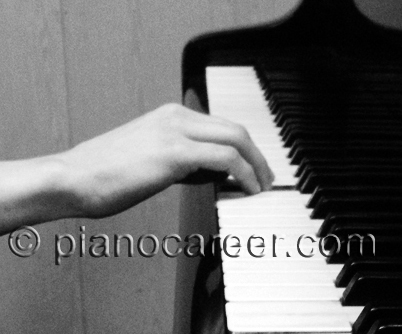
When practicing, imagine that the piano keyboard is not a rigid surface, but elastic and flexible: it can respond to the slightest fluctuations in the intensity of the applied pressure. Imagine that your fingers are ‘diving’ into the keyboard, not hitting it like hammers. Your back, your shoulders, your elbows, your forearms and especially your wrists have to be totally relaxed. All the weight of your arm has to have a single support point: your fingers.
I always tell my students that their arms should be like cat paws: soft, relaxed, flexible. Their fingers, though, should be like claws: sharp, having a brilliant articulation and, as Heinrich Heuhaus used to say – ‘always ready for battle!’. However, beware of allowing your fingers to be ‘in charge’. They are only the continuation of your arm, which, in its turn, is the continuation of your shoulders and back and, ultimately, of your mind and your hearing.
The free pressure of the entire weight of your arm, the controlled fingertips and the relaxed wrists (which will compensate and soften the pressure) will make the piano sound deep, free and expressive. Only such a sound will allow you to create a good legato and a meaningful flowing phrasing. I will write more in my next articles about the negative influence of the ‘percussion hit’ sound on legato and ‘horizontal’ phrasing. I’ll also explain (and demonstrate in a few video recordings) another key principle of the Russian piano school: the ability to ‘sing’ at the piano (also called the ‘intoning technique‘).
I usually tell my students that martial arts, especially aikido and jiu-jitsu, are a good source of inspiration: brutal force and tensed technique will not have any results. Only a relaxed approach will allow you to use your opponent’s strength and turn it against him. Performing art is based on the same principles: controlled relaxation, achieved with hard work and awareness, will result in a quality sound and a brilliant technique capable of expressing the most complicated musical ideas.
That’s why you should always pay attention to the quality of your sound, even when you’re playing scales, practicing some difficult technical places or just warming up. Be aware that a true musician plays with his soul and his mind, not just with his fingers.
At the same time, don’t forget about your ear training: never play mechanically, always listen to the objective quality of your sound! For being able to express the entire complexity of the wonderful piano repertoire, a student should understand from his first lesson how important it is to combine technique and expression in his daily practice.
If you enjoyed this piano tutorial, here are some other piano practice and learning topics you’ll like:
Developing a Brilliant Piano Technique – The Holistic Professional Approach
Keep Your Hands Strong and Your Mind Open
Understanding a Piano Piece: 11 Basic Steps
Between Pianissimo and Fortissimo. Improving the Piano Dynamic Range.
Constructive Tip for Piano Beginners – Avoid Staccato!
Overcoming Technical Difficulties – Between Stereotypes and Holistic Tendencies in Piano Playing